


Work · AI-Augmented Go-to-Market Consultants

Show the system. Then show what changed.

GAT connects business constraints to working architecture: intake, routing, follow-up, documents, integrations, reporting, and the controls that keep the process usable after launch.

  • 50+ Salesforce projects
  • 100+ integrations
  • 5.0 client rating
  • 6+ years Salesforce

System dossiers

The problem, the operating system, and what changed

Case studies from GAT engagements and GAT's own product. Clients are named where we have permission and anonymized where we don't; each platform belongs to the case where it was used, and every number is labeled as a business result or a delivery-scale measure.

Go-to-market systems · Tort Experts

A high-velocity intake business, from paid media to signed case delivered

Tort Experts runs a case-acquisition operation — paid media in, signed cases out to partner law firms. GAT built the sales-operations and marketing-operations systems it runs on inside one Salesforce org.

$10K → $360K+/mo

Monthly intake revenue recorded across the operating period — a business result

Challenge

Inbound inquiries arrived through six forms, an intake team of one re-keyed records, contracts were assembled case by case, call-center bursts threatened platform limits, and signed cases had to reach partner law firms without paralegals re-keying data.

System

GAT designed a normalized intake model in Salesforce and Litify, buffered Five9 call-center bursts behind Platform Events so lead routing survives peak volume, built per-litigation qualification questionnaires (the largest a 4,548-line flow) with eligibility rules in custom metadata a business user can update, mapped Docrio templates to record data ahead of Adobe Sign delivery, and shipped a distribution waterfall that auto-delivers signed cases and documents to 8+ partner-firm systems with per-firm auth and resend recovery.

Business change

The intake team grew from a single coordinator to a multi-seat operation on the new workflow, and during the system's operating period monthly intake revenue rose from $10K to more than $360K. That is a client before-and-after result, not a claim that software was the only growth variable.

Operating flow

  1. 01

    Capture

    Paid media + 6 inbound forms

  2. 02

    Buffer

    Five9 → Platform Events

  3. 03

    Qualify

    Per-litigation questionnaires

  4. 04

    Sign

    Docrio + Adobe Sign

  5. 05

    Deliver

    8+ partner-firm systems

Evidence note: Engagement records document the stack, the team expansion, and the monthly intake figures; the questionnaire and distribution counts come from a code audit of the org. Partner law firms are not named.

Patient communication · Goldfinch Health

Patient–nurse messaging built where the clinical data already lived

When Goldfinch Health needed off their previous patient-messaging vendor, GAT advised against another point solution and built the chat inside Salesforce — then migrated years of message history in.

100,000+

Patient messages managed on the platform, including migrated history — a delivery-scale measure

Challenge

A surgical-care navigation company was paying for a standalone messaging vendor while its clinical data lived in Salesforce. Leaving the vendor meant replacing real-time chat, preserving years of history, and serving Spanish-speaking patients without adding staff.

System

GAT architected a real-time, HIPAA-conscious patient–nurse chat on Platform Events and CometD inside Experience Cloud — read receipts, attachments, scheduled messages — migrated the historical message archive with our own ETL, added Gemini-powered live translation so nurses type English and Spanish-speaking patients read Spanish, and built an access-audit trail that has logged 34,860 record views.

Business change

Five years on, the platform manages 100,000+ patient messages, supports 15,314 surgeries, and serves 51 active users on an org with 166 authored Apex classes, 59 Lightning Web Components, and 2 authored Platform Event architectures. The message count includes migrated history — it measures the system of record, not chat throughput alone.

Operating flow

  1. 01

    Message

    Experience Cloud chat

  2. 02

    Deliver

    Platform Events + CometD

  3. 03

    Translate

    Gemini live translation

  4. 04

    Audit

    Access-event trail

  5. 05

    Support

    15,314 surgeries

Evidence note: Counts are SOQL aggregates from the production org (100,000+ messages managed, 15,314 surgeries, 34,860 access-audit events, 51 active users); component totals come from a code audit. No patient-level data appears anywhere in this dossier.

Sales system · B2B services

One follow-up system across calls, enrichment, and Salesforce

The project closed the seam between lead data, rep activity, next actions, and management reporting instead of asking reps to keep four tools in sync.

+50%

More leads converted after go-live, per client reporting — a business result

Challenge

Calls were not logged consistently, follow-ups depended on memory, and enrichment from Apollo.io and ZoomInfo sat outside the CRM. Managers could not see whether a lead was worked or merely assigned.

System

GAT connected Aircall CTI to Salesforce, logged calls against the right records, converted dispositions into follow-up tasks, brought enrichment into the lead flow, and surfaced call volume, compliance, and conversion in dashboards.

Business change

Client reporting showed 50% more leads converted after launch, with follow-up compliance above 95% in the first month. We present this as observed post-launch performance; rep execution and other commercial factors remained part of the result.

Operating flow

  1. 01

    Enrich

    Apollo.io + ZoomInfo

  2. 02

    Assign

    Salesforce

  3. 03

    Call

    Aircall CTI

  4. 04

    Orchestrate

    Dispositions + tasks

  5. 05

    Measure

    Sales dashboards

Evidence note: The platform list and post-launch figures come from this specific GAT engagement; they are not assembled from unrelated projects. Client identity remains confidential.

Integration · Behavioral health

Real-time EHR sync that ended swivel-chair data entry

A multi-state psychiatric health practice was running intake on duplicate entry between Salesforce and its EHR. GAT built the event-driven bridge in both directions.

38

Fields on the patient Platform Event syncing Salesforce and the EHR in real time

Challenge

Every new patient was typed twice — once into the EHR, once into Salesforce — and the two systems drifted. Appointment changes, new patients, and AI-answered phone calls all needed to land in the CRM without a human re-keying them.

System

GAT built EHR webhooks landing on Apex REST endpoints that publish 38-field patient Platform Events; Flows subscribe and update Person Accounts and appointments in real time, while outbound triggers push new patients back to the EHR with MRN writeback and full error logging. The practice's voice-AI phone agent was wired into the same pattern — AI-answered calls become structured Leads — and Shield Platform Encryption was rolled out over PHI fields.

Business change

Intake now runs on a single point of entry with the EHR and Salesforce in continuous sync, hardened across 16 iterative production deployments. We publish the architecture facts; no time-saved percentage was documented for this engagement.

Operating flow

  1. 01

    Receive

    EHR webhooks → Apex REST

  2. 02

    Publish

    38-field Platform Event

  3. 03

    Update

    Flows → Person Accounts

  4. 04

    Write back

    MRN to the EHR

  5. 05

    Protect

    Shield Platform Encryption

Evidence note: The Platform Event schema, subscriber flows, integration classes with tests, and 16 dated pre-deploy snapshots come from a code audit of the org. The client is anonymized and no patient data is referenced.

Integration · Behavioral health

Closed Won to a ready EHR patient record, automatically

A national addiction-treatment network wanted admissions to stop ending at Closed Won. GAT built the pipeline that carries a won Opportunity into the clinical system.

12

Idempotent API callouts orchestrated per admission into the behavioral-health EHR

Challenge

When sales marked an admission Closed Won, clinical staff still had to create the patient, open the episode of care, and file documents in the EHR by hand — and paper intake forms added another manual step before treatment could start.

System

GAT built a single Queueable that orchestrates 12 idempotent API callouts to the behavioral-health EHR on close — creating or updating the patient, opening the episode of care, and syncing documents — with token caching and environment switching held in custom metadata. Paper intake became a one-click PDF: a 48-field clinical screening rendered server-side and filed against the patient journey, plus inbound verification-of-benefits emails that attach themselves to the right Opportunity.

Business change

Sales sees revenue; clinical sees a ready patient record — the handoff between the two no longer depends on re-keying. We publish the pipeline's architecture; no cycle-time reduction figure was documented for this engagement.

Operating flow

  1. 01

    Close

    Opportunity Closed Won

  2. 02

    Orchestrate

    Queueable pipeline

  3. 03

    Sync

    12 EHR callouts

  4. 04

    Document

    48-field screening → PDF

  5. 05

    Attach

    VOB emails → Opportunity

Evidence note: Callout sites, the paired test class, and the screening-to-PDF pipeline are documented in a code audit of the org. The client and the EHR vendor are anonymized.

Automation · Behavioral health

A daily census that recalculates itself when dates move

For a multi-facility behavioral-health treatment center, the daily census is the number the whole business runs on — and it broke every time an admit or discharge date moved.

~1,630

Lines of Flow logic in the census recalculation engine — a delivery-scale measure

Challenge

Earlier admissions, later discharges, exclusions, and inter-facility transfers each broke the census differently, and staff were reconciling the number by hand while also running an admissions funnel on paper-adjacent steps.

System

GAT decomposed the problem into a declarative recalculation engine — one main flow and six subflows covering earlier and later admissions, discharges, exclusions, and inter-facility transfers, roughly 1,630 lines of Flow logic — delivered with six architecture briefs so the client's team owns it. Around it, GAT built the admissions funnel itself: pre-assessment, verification of benefits, and ops handoff, with record-type-aware clinical PDFs generated server-side and the SMS console staff already used embedded directly on record pages.

Business change

The census now recalculates itself when dates move, and the admissions funnel runs in Salesforce end to end. The published figure measures delivery scale; no error-rate delta was documented for this engagement.

Operating flow

  1. 01

    Change

    Admit / discharge dates

  2. 02

    Recalculate

    Main flow + 6 subflows

  3. 03

    Transfer

    Inter-facility logic

  4. 04

    Generate

    Clinical PDFs

  5. 05

    Message

    Embedded SMS console

Evidence note: Flow line counts, the intake-pipeline object and trigger inventory, and the SMS embeds come from a code audit. The client is anonymized; only aggregate architecture facts are published.

Document operations · Healthcare

Clinical paperwork generated from the Salesforce record

A large document library became a repeatable record-driven workflow for intake, consent, and clinical paperwork.

100+

Docrio templates configured — a delivery-scale measure

Challenge

Intake, consent, and clinical documents were being assembled from information already held in Salesforce, creating repetitive work and opportunities for inconsistent paperwork.

System

GAT mapped Salesforce record fields into more than 100 Docrio templates, organized the template set around the covered workflows, and made document generation part of the record process rather than a separate manual task.

Business change

Teams could generate the covered document set from Salesforce data instead of rebuilding each document by hand. We do not publish a time-saved or error-reduction percentage because one was not documented for this engagement.

Operating flow

  1. 01

    Record

    Salesforce

  2. 02

    Select

    Workflow + template rules

  3. 03

    Populate

    Field mapping

  4. 04

    Generate

    Docrio

  5. 05

    Review

    Operations team

Evidence note: The published proof is the implemented document library and workflow. It is intentionally not presented as a quantified business outcome.

Advisory & audit · SaaS

A production revenue org fully mapped before changing a line

A cybersecurity SaaS company handed GAT a production revenue org with no sandbox and no documentation. The engagement started with forensics, not changes.

~5,200

Metadata files retrieved and mapped into a version-controlled org atlas — a delivery-scale measure

Challenge

The org carried 216 flows, 45 custom objects, and years of undocumented decisions — with live revenue running through it and no sandbox to experiment in. Changing anything blind risked attribution, billing, and routing at once.

System

GAT retrieved roughly 5,200 metadata files and produced a version-controlled org map — attribution, billing, routing, and enrichment subsystems documented section by section, with AI-assisted analysis accelerating the archaeology. The forensic pass untangled two parallel attribution engines and two coexisting round-robin routing systems writing to the same records, caught live buttons wired to obsolete flows, and mapped the full HubSpot-to-Salesforce funnel.

Business change

The client got a de-risked org and a durable source of truth: every subsequent change is made against documentation instead of tribal memory. The published figures measure audit scope, not a revenue outcome.

Operating flow

  1. 01

    Retrieve

    ~5,200 metadata files

  2. 02

    Map

    216 flows · 45 objects

  3. 03

    Untangle

    Dual attribution + routing

  4. 04

    Document

    Version-controlled org map

  5. 05

    De-risk

    HubSpot → Salesforce funnel

Evidence note: File, flow, and object counts come from the retrieved metadata itself. The client is anonymized and no revenue or commission specifics from the engagement are published.

Payments infrastructure · Financial services

Encrypted bank files, generated and reconciled inside Salesforce

A national financial-services firm needed to move real money — FedWire wires and ACH — from inside Salesforce, within a managed-package loan platform.

AES-256

Encryption standard applied to every FedWire and NACHA file the system transmits

Challenge

Loan disbursements had to leave Salesforce as correctly formatted, encrypted FedWire and NACHA bank files, reach a top-tier U.S. bank's gateway, and come back as acknowledgment files that close the loop on every transaction — all inside governor limits.

System

GAT built the payments infrastructure: batch jobs that assemble bank-format files, encrypt them with AES-256-CBC, and transmit them to the bank's gateway; inbound REST endpoints that ingest acknowledgment files and reconcile every transaction's status; and a GL-to-Oracle export pipeline for the finance team. Everything shipped with paired test classes, end-to-end documentation, and QA scripts through formal pull-request review.

Business change

The firm moves wires and ACH from inside its system of record with a reconciled status trail on every transaction. We publish the architecture and rigor; transaction volumes and counterparties remain confidential.

Operating flow

  1. 01

    Assemble

    Batch bank-file builders

  2. 02

    Encrypt

    AES-256-CBC

  3. 03

    Transmit

    Bank gateway

  4. 04

    Acknowledge

    Inbound REST ack ingestion

  5. 05

    Reconcile

    GL → Oracle export

Evidence note: The authored class inventory, encryption implementation, and pull-request trail come from a code audit of the delivery. The firm and the bank are not named, and no file-format specifics are published.

AI operations · Travel & hospitality

An AI interface running a live rental business — safely

A Caribbean car-rental franchise wanted AI in daily operations, not a demo. GAT built the full tool surface, then carved out only the parts that are safe to expose.

114

MCP tools built over the rental platform's API — a delivery-scale measure

Challenge

The rental platform's API covers reservations, fleet, payments, and telematics — but handing an AI assistant raw write access to a live business is how demos become incidents. The client needed useful surfaces with hard guardrails.

System

GAT built a 114-tool MCP server over the rental platform's API, then carved two safe surfaces from it: a public ChatGPT app exposing exactly three read-only shopping tools behind strict output allowlists, and a private staff connector that annotates every tool, blocks writes by default, and gates payments, refunds, and deletes behind a second high-risk switch.

Business change

The system runs in daily operations today, with zero-diff schema parity verified after a full SDK rebuild. The published figure measures the tool surface delivered, not a revenue outcome.

Operating flow

  1. 01

    Wrap

    114-tool MCP server

  2. 02

    Expose

    3-tool public ChatGPT app

  3. 03

    Guard

    Output allowlists

  4. 04

    Gate

    High-risk write switch

  5. 05

    Operate

    Daily rental operations

Evidence note: Tool counts, the allowlisted public app, and rebuild parity are documented in the versioned codebase. The client is anonymized and platform-confidential material is excluded.

GAT product · ApexGenius

Our own AI product — proof we ship what we sell

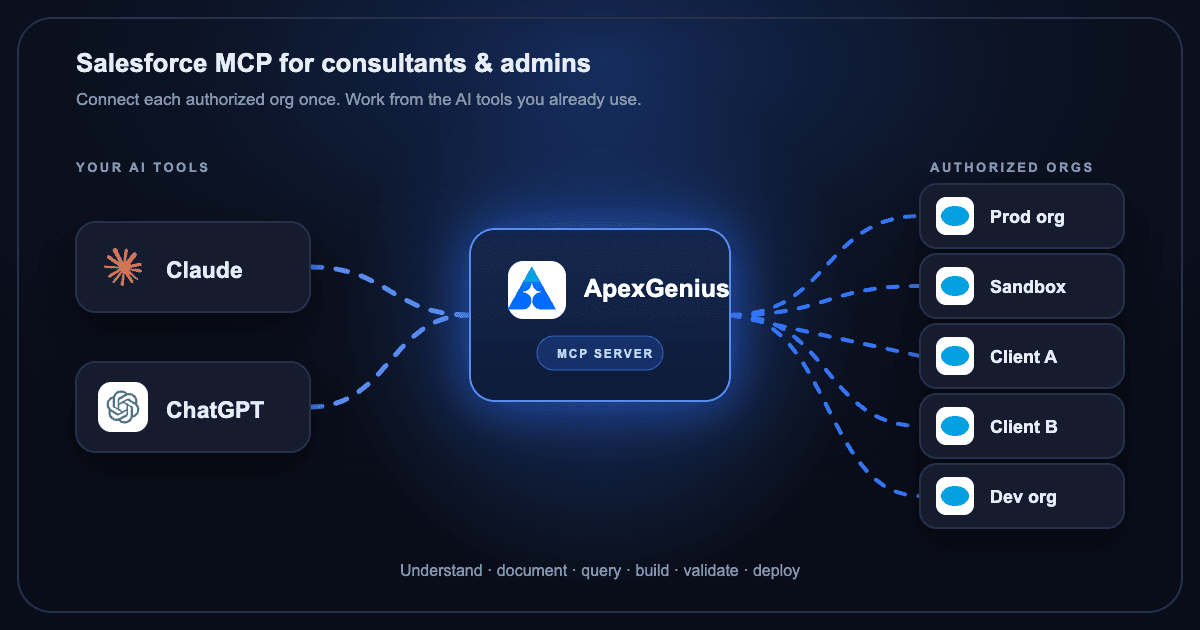
ApexGenius is a multi-agent AI copilot that answers natural-language questions about live Salesforce orgs and, through its MCP gateway, acts on them with guardrails.

16,550

AI answers delivered about live Salesforce orgs, as of July 2026

Challenge

Salesforce teams ask the same expensive questions — what does this org do, what breaks if we change it — and the answers live in metadata no one reads. GAT built the product it wished every client engagement started with.

System

A Python backend orchestrates 12+ specialized agents over a pgvector RAG corpus of 92,000+ metadata chunks, and an MCP gateway lets Claude read, stage, and deploy against a live org with guardrails and per-org access control — with audit logging and PHI-redaction controls built in as the product works toward HIPAA compliance.

Business change

As of July 2026, ApexGenius has delivered 16,550 AI answers, connected 47 Salesforce orgs, and metered 2,645 MCP tool calls. These are product-telemetry figures from our own database, published as adoption measures — not client revenue claims.

Operating flow

  1. 01

    Ask

    Natural-language question

  2. 02

    Retrieve

    92,000+ RAG chunks

  3. 03

    Orchestrate

    12+ specialized agents

  4. 04

    Act

    MCP gateway + guardrails

  5. 05

    Meter

    Audit + access control

Evidence note: Figures are SQL aggregates from the production database as of July 2026. ApexGenius is GAT's own product, so this dossier is first-party by definition — which is exactly why the numbers are labeled as telemetry.

Client perspective

What clients say after the system ships

Feedback from completed GAT engagements. GAT holds a 5.0 average client rating across 50+ Salesforce projects.

GAT Solutions helped build the Salesforce system almost entirely from scratch, with thoughtful solution design, clear communication, and dependable delivery.

Greenfield Salesforce system

Verified client review

GAT Solutions completed the required org changes quickly and explained the underlying issues, so the team understood what was changing and why.

Salesforce operating improvements

Verified client review

GAT Solutions brought strong Salesforce and development depth, communicated clearly, delivered within the agreed timeframe, and earned the client's confidence for future work.

Salesforce delivery partnership

Verified client review

Reviewer identities are withheld to protect engagement confidentiality. References can be arranged when permission and engagement context allow.

Initial systems consultation

Bring us the workflow that is slowing growth or service down.

  • You leave with
  • A focused consultation with a senior systems consultant
  • A current-state fit and architecture read
  • A recommended path — implementation, ongoing ownership, or product