

Stop re-keying at accepted admission
Carry the approved patient, episode, contacts, and eligible documents into the EHR at the milestone your operation already uses.
Behavioral Health
Salesforce EHR integration for behavioral health treatment centers: three integration shapes, costs, Health Cloud or not, and four systems in production.
30 minutes, free. Bring your EHR and your Salesforce edition.

 OpenAI Technical Practitioner
Salesforce connects to a behavioral health EHR through what the EHR vendor exposes: an API, webhooks, file exchange or a supported batch path. Salesforce owns inquiry, screening, admission coordination and follow-up, and the EHR stays the clinical system of record. The connection takes one of three shapes: an admission push that creates the patient, episode, contacts and documents in the EHR at accepted admission; an operational mirror that keeps Salesforce current from EHR events; or a connected operating layer that moves only selected operational facts. EHR identifiers write back to Salesforce, so repeat admissions attach to the right patient.
Where admissions leaks
Read the card titles first. If more than two describe your operation, the admission seam is already costing staff hours every week.
Calls and referrals arrive without a structured owner or action.
Staff re-enter the same demographics and insurance in two systems.
Accepted admissions are typed into the EHR by hand.
Every manual handoff is a chance to create a second record.
A missed webhook or callout goes unnoticed until it touches care.
Leaders rebuild census and follow-up by hand to trust the numbers.
The same six, carried by the system ↓
Every inquiry lands with a source, an owner, and a next action.
Patients are entered once and carried from screening to admission.
Accepted admissions become complete EHR charts automatically.
EHR identifiers write back, so repeat admissions attach to the right patient.
Exceptions surface with an owner and a recovery path.
Census and follow-up reflect operational truth without reconciliation.
Comparing how the two systems actually connect? Start with the three integration shapes below, then what each one costs.
The operating thesis
Your EHR can remain the home for treatment, documentation, prescribing, and billing. Salesforce can own inquiry, referral, verification, screening, admission coordination, and follow-up. The value appears when those roles are explicit and the handoff stops depending on a person.
We start with the operating seam, not a connector catalog. Then we choose the smallest reliable integration shape the vendor APIs, Salesforce limits, data sensitivity, and human recovery process can support.
Patient handoff rail
The rail makes system roles and operational failure points visible before anyone discusses endpoints or middleware.
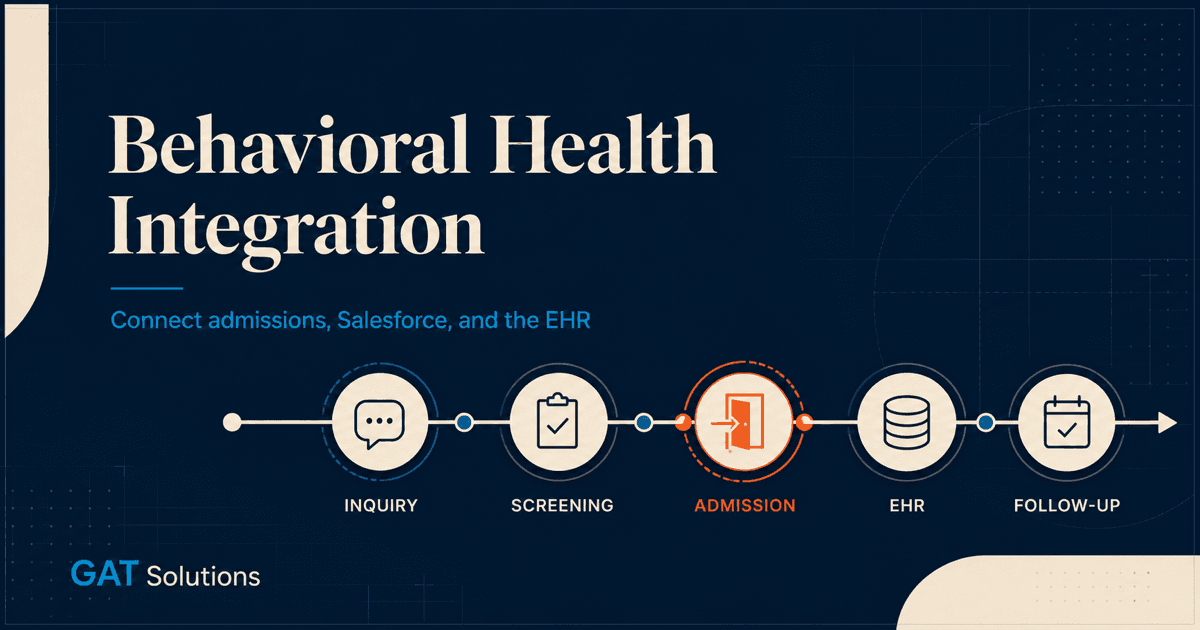
Inquiry → VOB / screening → Admission → EHR → Census / follow-up
Ownership above the node. Failure mode below it.
Architecture view · no patient data
Salesforce
Referral source, contact attempt, owner, and next action
Failure point
Calls and referrals arrive without a structured next step.
Salesforce
Eligibility work, screening status, documents, and follow-up
Failure point
Staff chase files, re-enter answers, or lose eligibility context.
Salesforce → EHR
The accepted-admission milestone and controlled handoff
Failure point
A person becomes the integration, and duplicates start here.
EHR
Clinical chart, episode of care, treatment, and billing truth
Failure point
The clinical record is late, incomplete, or disconnected.
Shared operations
Operational visibility, discharge changes, and outreach
Failure point
Leaders reconcile spreadsheets while patients fall out of view.
First useful target: replace the admission re-entry seam, preserve the EHR as clinical truth, and give operations a monitored recovery path.
Check my integration fitOperational outcomes
These are the operating conditions the architecture should create, not a list of connector features.
Carry the approved patient, episode, contacts, and eligible documents into the EHR at the milestone your operation already uses.
Write EHR identifiers back to Salesforce and make every create safe to retry, so repeat admissions attach to the right patient.
Give staff a visible exception, owner, and recovery path instead of letting a missed webhook or callout become silent drift.
Reflect the dates and statuses that matter to operations without asking leaders to rebuild the answer in a spreadsheet.
Behavioral Health Integration Fit Check
Bring your EHR, Salesforce edition, and the handoff your staff repeats.
From fit to ownership
The Fit Check qualifies the opportunity. The Blueprint contains the paid architecture work. Delivery and stabilization turn that definition into a system someone can actually own.
Qualify the likely shape, surface vendor-access risk, and decide whether deeper scoping is warranted.
Define record ownership, events, API capacity, identity, recovery, control questions, delivery phases, fixed scope, and price.
Implement against workflow acceptance tests, with monitored failures, documentation, and explicit responsibility on both sides.
Prove replay and retry procedures, train the owner, and document vendor changes, mappings, alerts, and escalation paths.
Monitor capacity, errors, retry age, vendor changes, and mapping health when the team wants us to keep the bridge operable.
Start with the current handoff and vendor access, not a shopping list of integrations. The first call determines whether there is a sensible path forward.
Check my integration fitThree integration shapes
Most operators need one direction done well before they need two directions done continuously.
Admissions lives in Salesforce; the EHR needs a complete record only after acceptance.
Salesforce → patient, episode, contacts, documents → EHR
Use one guarded milestone. Do not pay for a continuous two-way sync when one dependable handoff closes the operational gap.
This is the production pattern behind the Opus admission build.
Inspect the architecture →Clinical and scheduling teams work in the EHR while admissions and operations need current patient or appointment state in Salesforce.
EHR events → Salesforce; controlled writes → EHR
Decouple inbound events from record writes, preserve the EHR identifier, and monitor both directions.
This is the event-driven pattern behind the AdvancedMD integration.
Inspect the architecture →The EHR remains clinical truth, but census, intake documents, attribution, or follow-up need a stronger operating home.
EHR clinical truth ↔ selected operational facts ↔ Salesforce
Move the minimum useful data. Keep clinical narrative and clinical decisions in the system and teams designed to own them.
This is the shape behind the self-maintaining census and the intake document engine below.
See it in production →Systems this work connects
 Salesforce
 AWS
AWS Claude
 OpenAI
 MCP
MCP GoogleOpus EHRAdvancedMDn8nPlatform EventsREST + webhook APIs
Integrate or consolidate?
Integration is not always permanent and consolidation is not automatically simpler. Use the current clinical fit, ownership burden, access constraints, and migration risk to decide.
| Current reality | Better first move | Why |
|---|---|---|
| The EHR works for documentation, prescribing, treatment, and billing, but admissions lives elsewhere. | Integrate | Protect the clinical investment and fix the handoff creating duplicate work. |
| Teams re-key the same demographics, insurance, or intake packet in both systems. | Integrate | A defined system of record and one guarded handoff remove the immediate waste. |
| The vendor exposes partial APIs, limited webhooks, or restrictive batch windows. | Stage the bridge | Prove access and throughput first; use the narrowest reliable direction or cadence. |
| Both platforms are a poor operating fit and leadership has already justified migration risk and change. | Evaluate consolidation | Consolidation may reduce long-term complexity, but it is a clinical, financial, and adoption decision. |
| You need a near-term reduction in manual handoffs while the future platform decision is still open. | Integrate first | Close the expensive seam, measure the result, and preserve the option to consolidate later. |
The matrix is a scoping tool, not a clinical, compliance, legal, or procurement determination. The Fit Check replaces assumptions with your actual systems and workflow.
In production
Both run in production for behavioral-health operators.
AdvancedMD · operational mirror
A patient entered or updated in either system appears in the other within seconds, appointments included. Both systems agree on who the patient is, duplicate charts are stopped before they're created, and when something upstream breaks we see the error. The client doesn't discover it weeks later.
Opus · admission push
When admissions accepts a patient, the patient, their episode of care, their contacts, and their documents are created in the EHR automatically. Nobody re-keys the packet. A retry after a dropped connection never creates a second chart, and operations can re-send documents without calling engineering.
Verified client review
Behavioral health implementations
“Gray was a pleasure to work with. Easy to communicate with and knowledgeable about Salesforce and development in general. He completed the project within the timeframe we gave him, and I would definitely work with him again.”
The architecture links show what was actually delivered. The service behind them is Salesforce EHR integration, and it sits inside patient and case operations.
See selected work →A psychiatric practice, an addiction-treatment network, a multi-facility center, and a virtual mental-health provider. Every one of these runs on core Salesforce.
A multi-state psychiatric practice ran intake twice, once in Salesforce and once in the practice-management EHR, and the two records drifted within weeks.
A buffered two-way connection means a patient is entered once and appears correctly in both systems. When the EHR adds a field, an admin maps it without a deployment, and every failed sync lands somewhere a human will see it.
A national addiction-treatment network closed an admission in Salesforce and then started over, with clinical staff re-keying the patient into the EHR by hand.
The moment an admission is won, the patient, their episode of care, and their documents are created in the EHR, safe to re-run without ever producing a duplicate. The clinical screening files itself as a PDF and emailed benefits documents attach to the right admission.
A multi-facility behavioral-health center watched the daily census break every time an admit or discharge date moved, and someone rebuilt it by hand each morning.
Change a date and the affected stays recalculate across earlier admissions, later admissions, discharges, exclusions, and transfers between facilities. It is built with declarative automation on purpose, so the client's own team maintains and extends it.
A virtual mental-health provider needed full pre-assessment documentation without buying a document-generation package.
Staff complete intake, the right template renders for each intake type, and the finished PDF files itself against the patient record. No recurring license fee, and a data model the next feature builds on.
The same playbook holds across all four. Bursts of webhooks, calls, and AI activity are absorbed by a buffer instead of hitting the database, so busy days do not become outages. Field mappings live where an admin can change them. Every create is safe to retry, so a patient is never duplicated. Every failure lands somewhere a human will look. The psychiatric practice also wired its voice-AI phone agent into the same spine, so a call becomes a structured Salesforce lead with demographics and insurance captured mid-conversation.
The engineering write-ups are public: the AdvancedMD real-time architecture, the Opus admission pipeline, and AI phone intake that lands as structured leads.
Keep clinical work in the system clinicians trust, and add Salesforce only when it solves an operating problem the EHR should not own. The answer can be the EHR alone, core Salesforce plus the EHR, or Health Cloud plus the EHR. We start from the admissions journey, not a predetermined license.
| Option | Best when | What to test |
|---|---|---|
| EHR with built-in CRM | One platform covers inquiry through clinical and billing work well enough for the whole organization. | Referral depth, campaign attribution, multi-brand workflows, alumni, extensibility, and data portability. |
| Core Salesforce + EHR | Salesforce owns admissions, referrals, outreach, communication, or operational reporting while the EHR owns clinical truth. | System ownership, integration reliability, license mix, duplicate prevention, and support accountability. |
| Health Cloud + EHR | The healthcare data model, care workflows, patient context, and enterprise coordination capabilities earn their additional cost and ownership. | Implementation burden, overlap with the EHR, adoption, data-model fit, and total license cost. |
Health Cloud is not automatically required. Salesforce currently lists Health Cloud Enterprise at $350 per user per month and Unlimited at $525 per user per month, billed annually (current Health Cloud pricing). Those are platform license prices, not an integration estimate. Every system on this page runs on core Salesforce, and the integration approach works on either foundation.
If the EHR's own CRM already covers the workflow and the real issue is adoption or governance, integration is the wrong answer. If nobody can name the authoritative system for the records being synchronized, another license will not solve the operating ambiguity. When both systems have real daily users and one patient, the connection pays: two teams, two systems, and nobody re-keying.
A search for the cost produces numbers that look precise and describe completely different projects. Anyone quoting off a requirements sheet is guessing. We price from discovery: four questions move the number, and you get a fixed price before a build starts, never an hourly meter.
Some vendors only let outside systems read records, not create them, and some charge separately for the access. We confirm what your vendor allows and what they charge before anything is priced.
A patient handed to the EHR once at admission is a smaller project than two systems staying in step all day. We find the smallest version that removes the manual work.
Duplicate patients and silently missing records are why staff stop trusting integrations. Preventing both is real work, and we price it in rather than pretend it will not happen.
Someone has to notice when the EHR vendor changes something. We either run it with you or hand it to your team with documentation. Skipping this is how integrations die in year two.
The Fit Check, free, 30 minutes. You bring the EHR, the Salesforce edition, and the step your staff repeats. You leave with the probable shape, the access risks to verify, and an honest recommendation, even when it is no custom build.
The Blueprint, paid, when the workflow warrants it. Which system owns each kind of record, exactly what moves and when, the duplicate and failure rules that keep staff trusting it, what your vendor agreement and compliance review require, and who owns it after launch. It ends in a fixed proposal.
The build. Fixed scope, fixed price, delivered in weeks, stabilized with documentation and an accountable owner. No change-order ambush, because discovery already answered the questions that cause them.
"The vendor supports FHIR" does not prove an admissions workflow can write records. AdvancedMD, for one, states that its regulatory FHIR implementation is read-only and that transactional writeback uses its Connect APIs under a developer agreement with licensing and support fees (AdvancedMD FHIR guidance). That access work belongs in the estimate, and so does the vendor's recurring fee. We also budget Salesforce API headroom for normal volume, bursts, retries, and replay rather than counting endpoints.
30 minutes, free. Bring your EHR, Salesforce edition, and the handoff your staff repeats. You leave knowing the probable integration shape, the access risks to verify, and the honest next step.
Whether the workflow points to an admission push, real-time mirror, or connected operating layer.
The vendor endpoints, webhooks, authentication, sandbox, licensing, and volume facts that can change the scope.
The ownership, identity, duplicate, or failure-recovery decision most likely to determine whether the handoff works.
Whether the seam is ready for a paid Blueprint, needs vendor discovery first, or does not justify a custom build.
No-PHI working rule. Use field names, sample schemas, redacted screenshots, and process notes. Do not send patient records, clinical narrative, or other PHI for the initial Fit Check.
Research before the call
Use the write-ups below to brief IT, compliance, or finance before you map the workflow with us.
Reliability playbook
Separate incoming Salesforce requests from outbound EHR callouts, then model polling, events, retries, and operating reserve.
Open resource →
AdvancedMD architecture
See the webhook, Platform Event, Flow, identity-writeback, and exception pattern from the audited production build.
Open resource →
Opus architecture
Follow the guarded sequence that creates a patient, episode, contact, and eligible documents without re-keying.
Open resource →
AdvancedMD sync
The field map in each direction, and the four guards that keep one patient to one chart.
Open resource →
Census design
The flow and the six correction cases behind a census that stays right when admit dates, discharge dates and facilities change.
Open resource →
Healthcare advisory
See how we approach Salesforce, EHRs, patient access, communication, operations, and responsible AI.
Open resource →
Care navigation
Messaging, presence-aware routing, nurse consoles, and engagement analytics for care-navigation and surgical episode programs.
Open resource →
Selected work
Review the systems, integrations, and operating changes behind the consultancy.
Open resource →
Behavioral health integration questions
Behavioral Health Integration Fit Check
Free, 30 minutes, no obligation.
AutomaticAn accepted admission becomes a complete patient chart