
Behavioral health integration fit check
30 minutes · Please do not submit PHI
Choose the smallest integration that removes the handoff.
Bring your EHR, Salesforce edition, and the step your staff repeats today. Leave with the recommended shape, known API or access blockers, and a practical next step.
Admission push
Create the patient, episode, and packet when the admission milestone is reached.
Real-time sync
Keep patient and appointment changes aligned while both teams stay in their system.
Operating layer
Add census, VOB, documents, and attribution around the clinical system.
Every behavioral-health operator we've worked with runs on two systems that don't talk: a CRM where admissions, marketing, and follow-up live, and an EMR where clinical and billing truth lives. The bridge between them is usually a person: someone re-keying demographics, insurance details, and clinical documents twice per patient. That gap has a real cost, and it compounds:
- Admissions capacity spent on data entry. Coordinators who should be moving patients through the funnel are transcribing packets into the EMR, per admission, every admission.
- Drift nobody trusts. When the same patient exists twice, the two records disagree within weeks. Staff start checking both systems, which means the "time-saving" CRM quietly added work.
- Duplicates that poison reporting. Naive syncs re-create patients and re-insert clinical history. Census, revenue, and outcome numbers stop being answerable.
- Marketing spend with no closed loop. You know what an ad click cost; you can't see which clicks became admitted patients, so budget decisions run on faith.
We've closed that gap in production for a multi-state psychiatric practice on AdvancedMD, a national addiction-treatment network on Opus Behavioral Health EHR, and multi-facility and virtual providers with Kipu-linked operating builds. This page is about what these projects look like as business decisions: what you get, how we scope, and which shape fits your operation. The engineering deep-dives are linked for whoever on your team wants to go under the hood.
What changes for your operation
The deliverable isn't "an integration." It's a set of operating outcomes your leadership can hold:
- Remove re-keying at admission. When a patient converts, the EMR record (demographics, episode of care, emergency contact, and the full document packet) exists automatically. For our addiction-treatment client, the paper-packet step disappeared entirely.
- One patient, everywhere. Repeat admissions attach to the existing patient instead of creating a second chart. The duplicate risk is addressed at the design level instead of deferred to a cleanup project every quarter.
- Documents that file themselves. Clinical screenings render to branded PDFs in one click; returned verification-of-benefits documents attach to the right patient automatically; the whole packet lands in the EMR at admission.
- Numbers leadership can trust. A daily census that recalculates itself when admission dates move. Attribution that connects ad spend to admitted patients, not to form fills.
- A system your team owns. We hand over architecture briefs and documentation, and field mappings live in configuration, so an admin handles the EMR renaming a field, not a change order.
How the Fit Check and paid Blueprint scope the project
We don't start from the EMR's API documentation. We start from your admissions workflow. The 30-minute Fit Check qualifies three questions before either side commits to a full architecture exercise:
1. Where does each record need to exist, and at what moment? If clinical staff live in the EMR all day, Salesforce needs to mirror it continuously. If your admissions team lives in Salesforce and the EMR only needs the patient once they're admitted, the integration is simpler (and cheaper) than a full two-way sync. Most operators need one direction done well, not both done poorly.
2. What is your team doing by hand that a system should absorb? Re-keying is the visible cost; the audit usually surfaces more: screening forms filled from scratch when the data already exists, VOB documents forwarded and manually attached, census spreadsheets rebuilt when a date changes.
3. What breaks trust today? Duplicates, drift, or a number nobody believes. That failure decides where the engineering rigor concentrates.
The Fit Check produces a probable integration shape, the risks that still need verification, and a recommendation: vendor discovery, a paid Blueprint, or no custom build. When a Blueprint is warranted, it defines record ownership, events, API capacity, identity and recovery, delivery phases, fixed scope, and price. Then we build, test against the real workflow, and stabilize the system with documentation and an accountable owner.
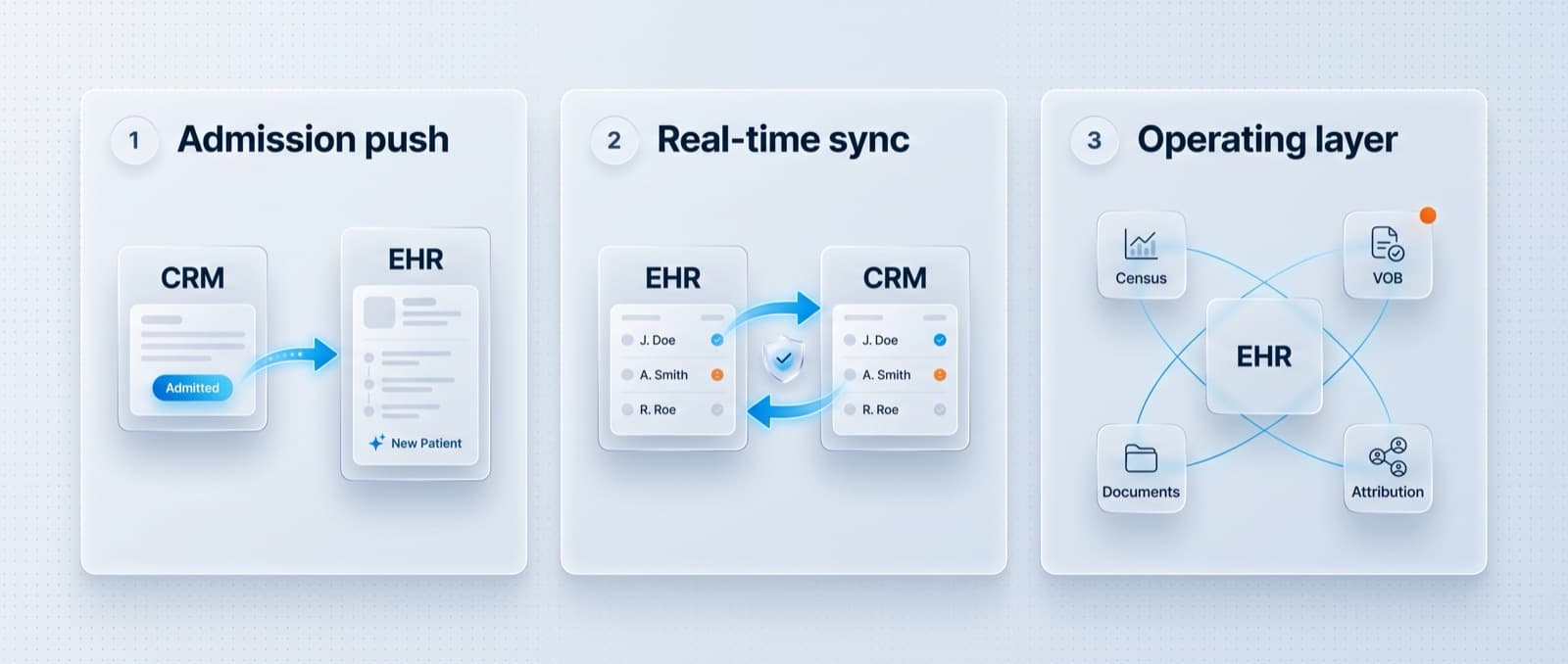
The three shapes these projects take
| Shape | Fits when | What we've built |
|---|---|---|
| Real-time sync | Clinical staff live in the EMR; the CRM must mirror patients and appointments continuously | Bidirectional AdvancedMD sync for a psychiatric practice: demographics and appointments flow in real time, with encryption over PHI fields |
| Admission push | Admissions runs in Salesforce; the EMR record should exist the moment a patient is admitted | Automated Opus Behavioral Health EHR admission pipeline for an addiction network: patient, episode of care, and full document packet created automatically |
| Operating layer | The EMR stays the clinical system; the business needs census, documents, and attribution the EMR can't provide | Multi-facility census that recalculates itself, click-to-admit ad attribution, and clinical PDF generation across four intake types |
API access is part of the scope, not an assumption. AdvancedMD's current interoperability guide says its FHIR APIs are read-only and that transactional create, update, and delete work requires its Connect APIs, a developer agreement, sandbox testing, and production approval. We verify that access before treating a workflow diagram as an implementation plan.
These compose: the psychiatric practice runs real-time sync and an operating layer; the addiction network runs an admission push and document automation. For teams that want the engineering detail, the deep-dives are public: the AdvancedMD real-time architecture, the Opus Behavioral Health EHR admission pipeline, and the full behavioral-health build library, including AI phone intake that lands as structured leads.
Free 30-minute call
Which shape fits your operation? Find out on one call.
Bring your EHR, Salesforce edition, and the step your staff repeats. Leave with the probable integration shape, the access risks to verify, and an honest recommendation, even if it is "no custom build."
Why operators pick us for this
Behavioral-health EMR integration punishes generalists. The hard parts aren't in any connector's brochure: EMRs that mint a duplicate chart if you push the same patient twice, clinical history that re-inserts itself on every sync until reporting is unusable, encrypted PHI fields that quietly break the filters an integration depends on. We've hit each of those in production and engineered the identity, retry, and reconciliation guards, then delivered the documentation that makes those decisions inspectable. And because the same team builds a production Salesforce AI product, the integration you get is built by people who operate systems, not just deliver them.
For PHI, payload scoping starts with HHS's minimum-necessary guidance. The integration can provide technical controls and evidence for your compliance program; it cannot make the program compliant on its own. Scoping, building and running that connection is our EHR integration service.
Frequently asked questions
Can Salesforce integrate with a behavioral-health EMR?
Yes. We run these integrations in production for psychiatric, addiction-treatment, and virtual mental-health providers, on EMRs including AdvancedMD and Opus Behavioral Health EHR. The right shape depends on where your team actually works: if clinical staff live in the EMR, Salesforce can mirror agreed patient and appointment events; if admissions lives in Salesforce, the EHR record can be created automatically at admission.
What does a project like this cost and how long does it take?
These are fixed-scope builds, typically delivered in weeks, not open-ended integration programs. The 30-minute Fit Check qualifies the likely shape and blockers; it does not promise a free architecture. When deeper definition is warranted, a paid Blueprint maps ownership, events, API capacity, identity, recovery, delivery phases, fixed scope, and price before the build begins.
Will this disrupt our admissions team during rollout?
The rollout is designed to minimize disruption by wrapping around the workflow your team already runs. Admissions keeps working its pipeline while we test the downstream steps: creating records in the EHR, filing documents, and surfacing failures for review. We deliver with documentation and architecture briefs so your team can own the system after launch.
How do you keep PHI safe in a Salesforce-EMR integration?
We design payloads around minimum-necessary data, use Shield Platform Encryption on PHI fields where warranted, configure error logging to exclude clinical narrative, and hold integration credentials in protected configuration. Those controls support (but do not replace) the program-level work that compliance rests on: your BAA with Salesforce, access policies, risk analysis, and training.
We already tried a connector and it made duplicates. Why would this be different?
Because identity and retry behavior are engineered rather than assumed. Our builds decide explicitly who owns each record, reuse the existing EHR patient for repeat admissions, and add re-entry guards around expected retries. One build exists specifically because a naive sync had produced hundreds of thousands of duplicate rows. We have cleaned up after that shortcut, so identity and reconciliation are part of the design from the start.
Running admissions on a CRM and an EMR that don't talk? Bring us the workflow: the consultation maps your integration shape and the fixed-scope path to it. Or see the behavioral-health admissions practice.